I’m an astrophysicist interested in the orbital structures of planetary systems.
I'm currently a Ph.D. candidate in Astronomy at the University of Wisconsin–Madison, working with Juliette Becker. Before UW–Madison I was an undergraduate at the University of Washington (the other UW), where I majored in physics and astronomy and minored in linguistics and math. While there I worked with Rory Barnes and the VPLanet group. Having grown up in western Wisconsin and moved to the Seattle area in high school, I seem to just be getting passed back and forth between these states, placing my barycenter somewhere in rural Montana.
My Research
I'm a theorist who studies few-body gravitational systems (usually stars and planets) using both analytic and numerical techniques. My main interests lie in identifying and characterizing the dynamical processes that have produced the predominant orbital architectures of observed exoplanet systems. I'm also interested in planetary habitability.
Generating mutual inclinations in multiple-planet systems
A cartoon animation of artificial gap complexity amplification in systems of tightly packed inner planets (STIPs) perturbed by large outer giant companions (OGs). As the inclination of the OG decreases, the inclination dispersion in the STIP increases to conserve angular momentum, yielding inner planets that cannot all be seen to transit at once.
Due to their high abundance in the observational sample of multi-planet systems, "peas-in-a-pod" systems are ever a subject of study and debate. Previous work has shown that tightly packed planetary systems such as these possess more irregularly-spaced orbits when there is an accompanying exterior gas giant. No such effect is found in these systems when the outer companion is a star. I modeled the evolution of thousands of hypothetical tightly packed systems with and without giant companions, and found that secular interactions between the planets can fully account for this observational trend. In particular, the gravitational effect of the exterior gas giant companion is to "lift" planets in the inner system out of the transiting plane, causing them to go unobserved and introducing artificial gaps in these systems. The further implication is that more observed systems exist in these tightly packed, "peas-in-a-pod" configurations than we have counted.
Habitable worlds across a diversity of planetary systems
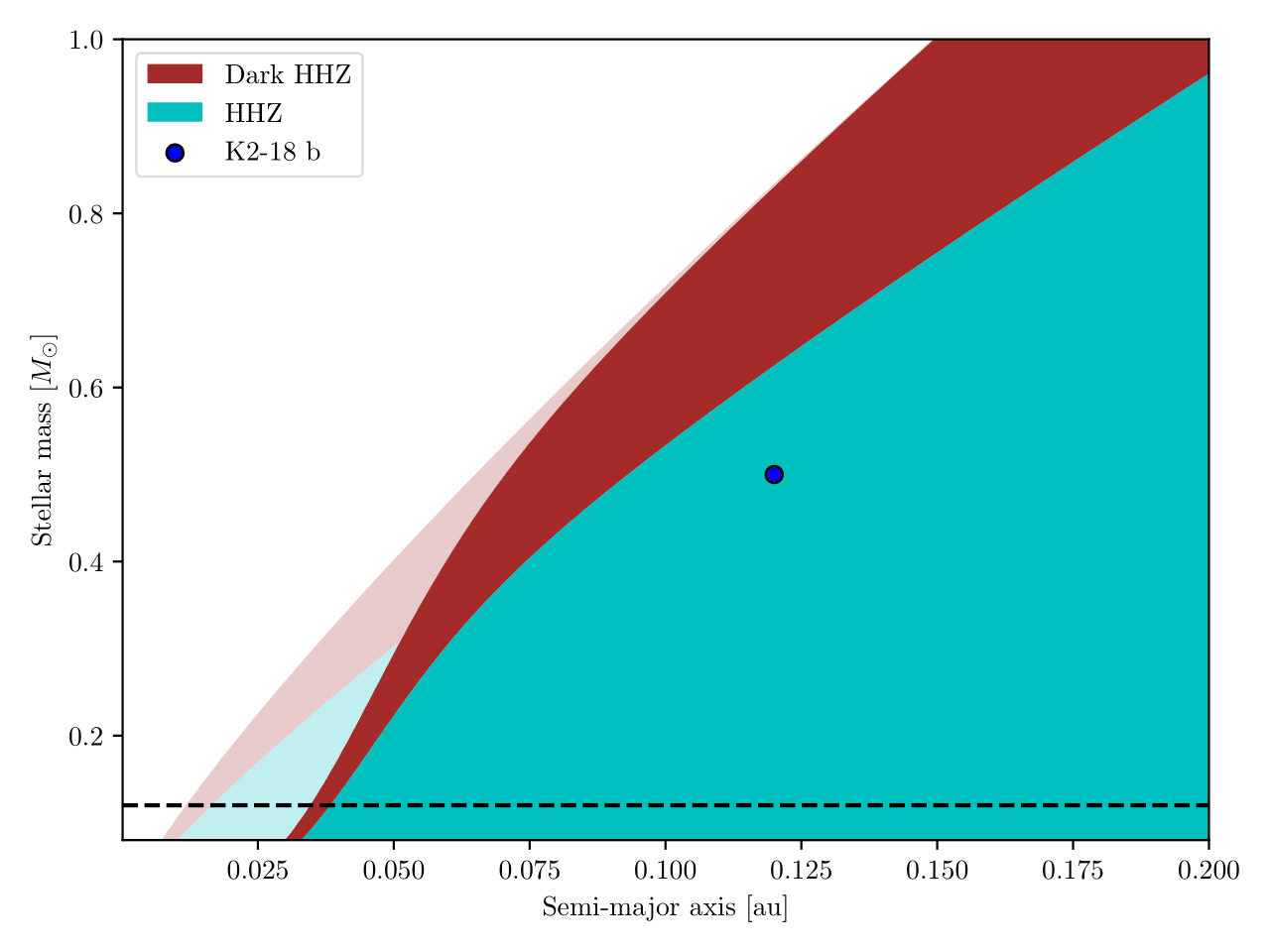
An adjusted "hycean habitable zone" (HHZ), accounting for equilibrium tides at a moderate eccentricity. The lighter colors show the original HHZ calculated by Madhusudhan et al. (2021).
Recently, astrobiologists have become interested in "hycean" planets, a theoretical class of exoplanets. Hyceans are sub-Neptune sized worlds with extremely deep oceans and icy interiors. I showed that due to the extreme static response of ice to tides, hycean planets inhabit a narrower habitable zone than had previously been represented in the literature. This effect arises from tidal heating becoming extreme for close-in orbits.
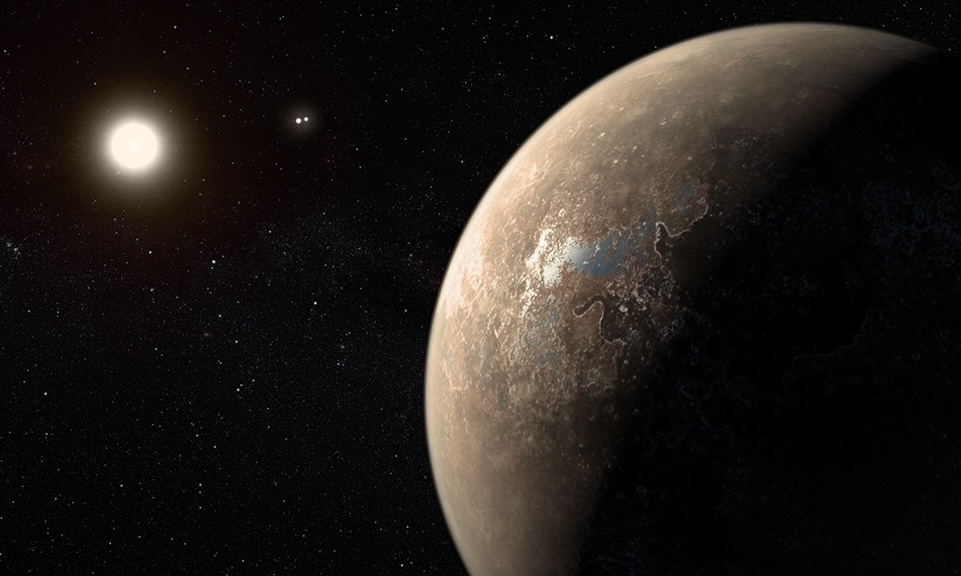
Artist's impression of Prox Cen b. (Credit: ESA/M. Kornmesser)
As an undergraduate and post-bac, I studied the possible dynamical histories of the Proxima Centauri planetary system. This system is of great interest to astrobiologists, as it is the closest system to our own and contains a potentially habitable world: Prox Cen b. I evaluated the orbital stability of the system across a broad parameter space in order to constrain its possible starting conditions. I also took several such stable configurations and ran simulations of the system's orbital dynamics and tidal evolution over its lifetime. The primary findings are that both inner planets must have started out with moderate orbital eccentricities, and that tidal forcing on Prox Cen b can persist for many billions of years, providing an additional energy source to heat the surface.
I am currently stepping out of my exoplanets comfort zone to work on few-body dynamics on a greater mass scale. In particular, I am simulating repeated encounters between black hole binaries and unbound companions at pressure traps within AGN disks. These interactions constitute a promising formation channel for gravitational wave sources in AGN. We seek constraints on the eccentricities of resulting binary mergers.
To better understand the influence of outer giant companions on compact planetary systems, I am thinking about the “chain-breaking” epoch in these systems—when the inner planets relax out of their initial mean motion-resonant chain—to identify the effect of precession due to the outer giant.
Outreach
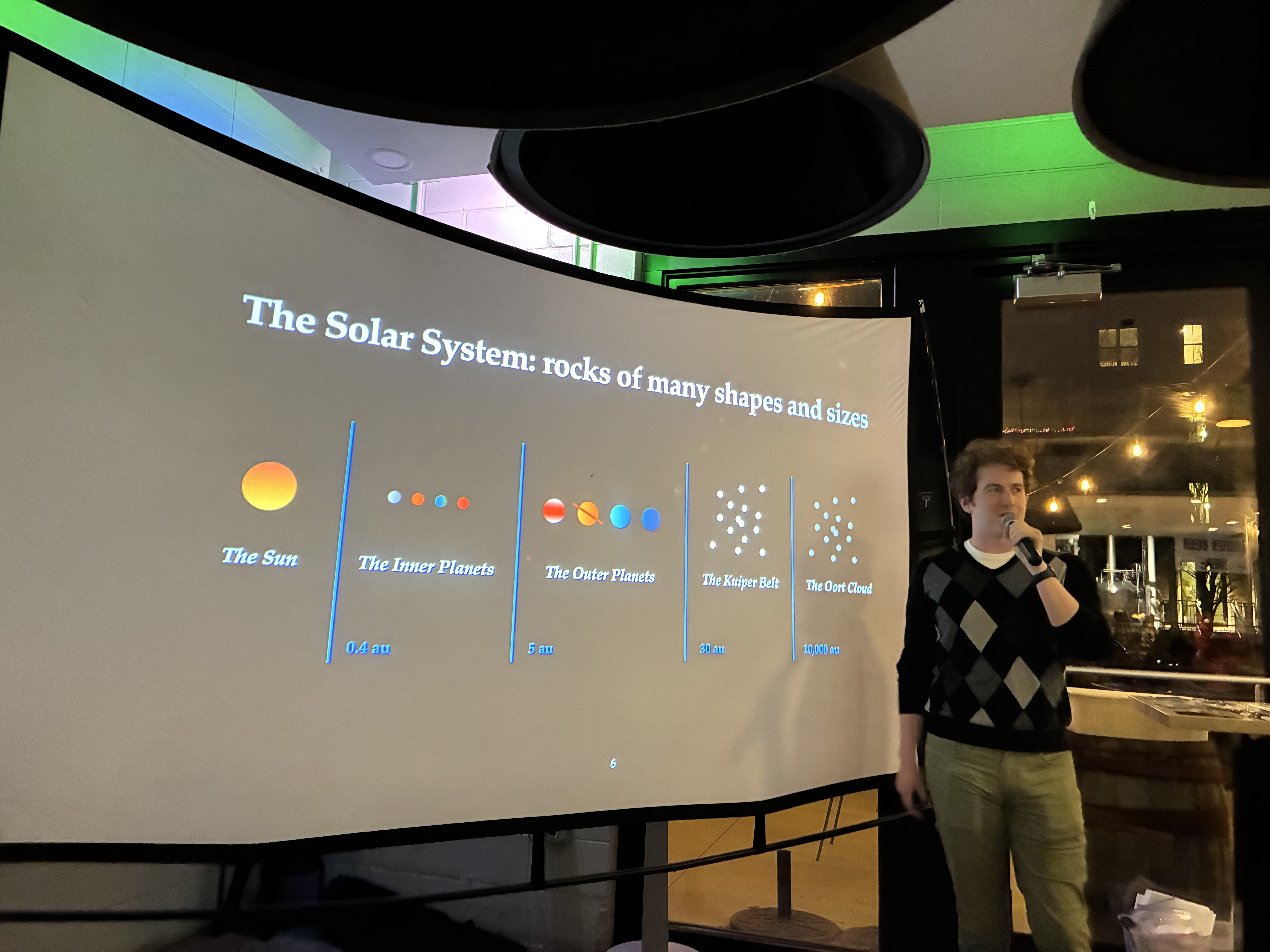
Giving my talk "The Ninth Planet(s) of the Solar System" at Madison AoT.
I’m currently one of two graduate students running Madison Astronomy on Tap (AoT). Every third Tuesday of the month during the academic year we host AoT at one of Madison’s excellent local breweries. Each event comprises two public talks from astronomers at UW–Madison or visitors to our department.
If you are an astronomer visiting UW–Madison and would like to present at AoT, please don’t hesitate to reach out at the email below!
madisonastronomyontap (at) gmail (dot) com
Curriculum Vitae
See the full list of my scholarly works on ADS here.
Here is my full CV.
Education
Ph.D. Astronomy, University of Wisconsin–Madison, expected 2028
M.S. Astronomy, University of Wisconsin–Madison, 2025
B.S. Physics and Astronomy, University of Washington, 2022
Honors and Awards
WSGC Graduate & Professional Research Fellowship (2025)
Blair Savage Travel Award, University of Wisconsin–Madison (2025)
Fluno Graduate Fellowship, University of Wisconsin–Madison (2023)
Mary Gates Research Scholarship, University of Washington (2020)
LOC, Great Lakes Exoplanet Area Meeting (November 2025)
SOC, VPLanet Workshop (September 2022)
Selected Publications
"Discovery and Characterization of the TOI-4468 Planetary System: A Transiting Hot Jupiter With a Lone Nearby Outer Companion." J. R. Livesey, B. J. Hord, J. Becker, A. Vanderburg, J. E. Rodriguez et al., accepted to AJ.
This is bold and this is strong. This is italic and this is emphasized.
This is superscript text and this is subscript text.
This is underlined and this is code: for (;;) { ... }. Finally, this is a link.
Heading Level 2
Heading Level 3
Heading Level 4
Heading Level 5
Heading Level 6
Blockquote
Fringilla nisl. Donec accumsan interdum nisi, quis tincidunt felis sagittis eget tempus euismod. Vestibulum ante ipsum primis in faucibus vestibulum. Blandit adipiscing eu felis iaculis volutpat ac adipiscing accumsan faucibus. Vestibulum ante ipsum primis in faucibus lorem ipsum dolor sit amet nullam adipiscing eu felis.
Preformatted
i = 0;

while (!deck.isInOrder()) {
    print 'Iteration ' + i;
    deck.shuffle();
    i++;
}

print 'It took ' + i + ' iterations to sort the deck.';